

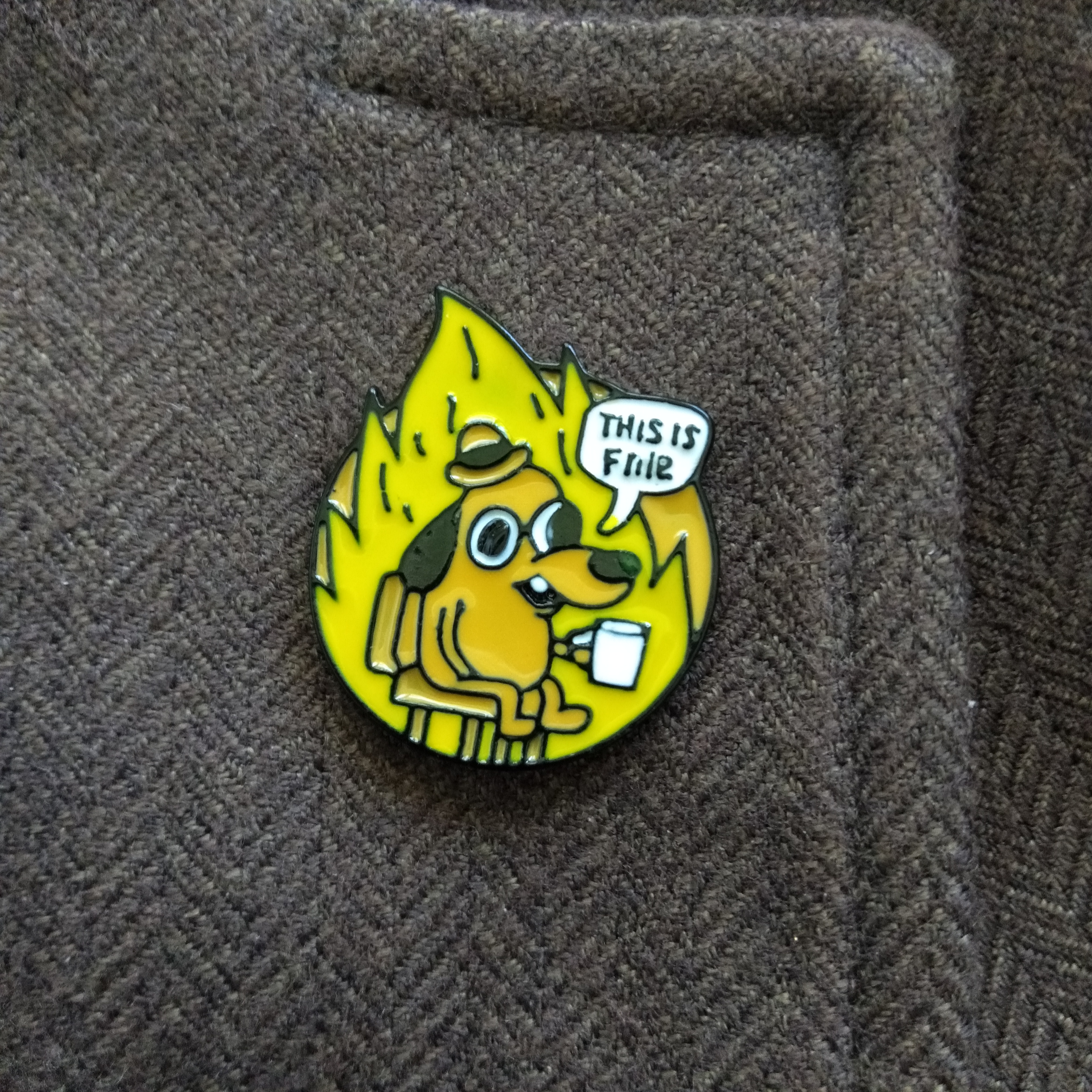
29 Oct A doorway to meaningful mental health discussion – my most important pin yet
A meme most can relate to, whilst we smile at the cute doggo here smiling and ironically stating ‘This is fine’ while the room burns, we need to remember how important it is to stop and listen to others and have an actual conversation. Don’t know your meme’s, read up here.
How often do we ask someone “how are you?” out of politeness, only to get a generic “good thanks, you?” in return? Yet deep down, the individual might be struggling and could really do with an honest and deep conversation.
Founded 10 years ago, Australian non-profit suicide prevention organisation ‘R U OK?‘ recently had their annual R U OK? Day and it was terrific to see so many Australian businesses, schools, sporting institutions and media outlets promote the campaign so strongly. I encourage everyone that isn’t familiar with the organisation to read up on their website.
Thursday October 10th was also World Mental Health Day (10th of the 10th), raising awareness that 1 in 5 Australian’s are affected by mental illness, yet don’t speak out due to the associated stigma. Each year, more and more awareness is made towards how normal it can be to feel flat and down, and the importance of seeking help when you feel as such.
The trouble is that when you are feeling flat, reaching out for help is not at the front of your mind, and therefore a meaningful conversation initiated by someone else could help change your life. If you ever suspect someone isn’t doing well then a conversation may be the best thing for them. I wear this pin to provide the small-talk platform to open the door for such meaningful discussion.
Every interaction may benefit from such discussion, these are some examples just from my own industry:
Mental health awareness for migrants:
It’s stressful enough moving to a foreign country, learning a new language, paying bills and working towards your Australian-dream all whilst maintaining a fake smile within the friendly and overt Aussie culture. Common concerns I hear from migrants include:
“I had heard finding work in Australia was hard, but I struggled for more than a year to find the work that was right for me”.
“I didn’t realise that even though I was qualified and experienced in my home country, that I was a no-body in Australia and needed to start again.”
The journey can be lonely and the days roll into months without the right guidance, which is why I love talking at universities to their international students before they graduate and start the next stage of their journey.
The right conversation at the right time could be the motivational boost you need.
Mental health awareness for employers:
It’s hard enough having to manage a business, manage your staff, manage your own life, and never drop the ball when it comes with professional interactions, but maybe those other business professionals you are in discussion with are struggling just as you are. Sometimes letting a little of the ‘real you’ be shown beyond the professional wall can help manage the endless day-to-day a bit more bearable. I couple months ago I attended a networking event and learned about the Johari Window, and I encourage all business owners to look into it. It is a technique business leader’s use that helps you understand your relationship with yourself and others. Whilst I’ve made it relevance for mental health, the Johari Window technique is first and foremost for personal branding and I encourage all business owners, managers, and fellow entrepreneurs to read up on it here.
Mental health awareness for migration agents:
It is an emotionally rough profession to work in, having to manage everything that I described above that a typical employer has to handle, but also the emotional stress of ‘make or break’ the Australian-dream for our clients. Sometimes, it can be reuniting couples or parents with children, or helping individuals and families to escape their countries whose claim for international protection as a refugee has not yet been determined. Legal Training Australia (LTA) have started running webinars this year about mental wellness and fatigue specifically for our profession, which is huge step towards awareness and assistance that Registered Migration Agents are not immune to mental health challenges. It is alarming how needed such a topic is, and I applaud LTA for identifying and servicing such need.
If you’ve read this far then good on you, seems the topics of suicide prevention and overall mental health and wellness are just as important to you too! I hope I’ve inspired you to make your next few conversations meaningful ones.
Readers seeking support and information about mental health or if you ever need someone to talk to then you can contract two fantastic not-for-profit organisations for FREE 24/7, they are Lifeline on 13 11 14 and also Beyond Blue on 1300 22 4636. Both free, both 24/7. A helpful trained person to speak to is only a phone call away. You don’t need to be an Australian citizen or PR, you just need a telephone.
Evan fully recommends Mem at work, a part of the Mace Energy Method and Causism institute, a non-invasive and non self disclosure therapy method that can put you back in charge of your own life to live your own dreams. You can also read Evan’s introductory statement to Mem at Work here.
Authored by Evan Bishop (MARN 1679414), owner of Worldly Migration and Recruitment Consultancy, and believer that no one should ever feel like they are truly alone.

| Article - A look into the factors influencing skilled migrant career progression
Posted at 19:32h, 08 December[…] Whilst lots of factors are determined by Governmental policy and ‘right place right time’, there is an element of choice, and the journey for some can be very disheartening coming to ‘the land of opportunity’ only to find yourself in an unprecedented mental health battle. […]