


27 Jan How to Get Priority Processing on a 482,494 and 186 Visas (2026 Guide)
One of the most common questions we receive from employers and visa applicants alike is:
“How do I get priority processing for my 482, 494, or 186 visa?”
Surprisingly, there is very little clear, plain-English information online answering this question. Most people search for phrases such as “482 visa priority processing” or “how are employer sponsored visas processed”, yet the answer is actually quite straightforward once you understand how the Department allocates priority.
In this blog, we break down how the Subclass 482 (Temporary Skill Shortage), Subclass 494 (Skilled Employer Sponsored Regional), and Subclass 186 (Employer Nomination Scheme) visas are processed, and what actually determines whether an application is assessed faster than others. The good news is that the system is guided by clear rules set out in Ministerial Direction No. 105, which determines the order in which skilled visa applications are assessed by the Department of Home Affairs (DHA). Understanding these priorities can help you or your employer position your application for potentially quicker outcomes.
What is Ministerial Direction No. 105?
Introduced in December 2023, Ministerial Direction No. 105 outlines the Australian Government’s policy priorities for processing skilled visas. It applies to a range of visas, including the 482, 494, and 186 subclasses. The direction aims to support regional development, fill critical skill shortages in essential sectors, and reward trusted employers.
According to the official DHA website, skilled visa applications are processed in a specific order of priority.
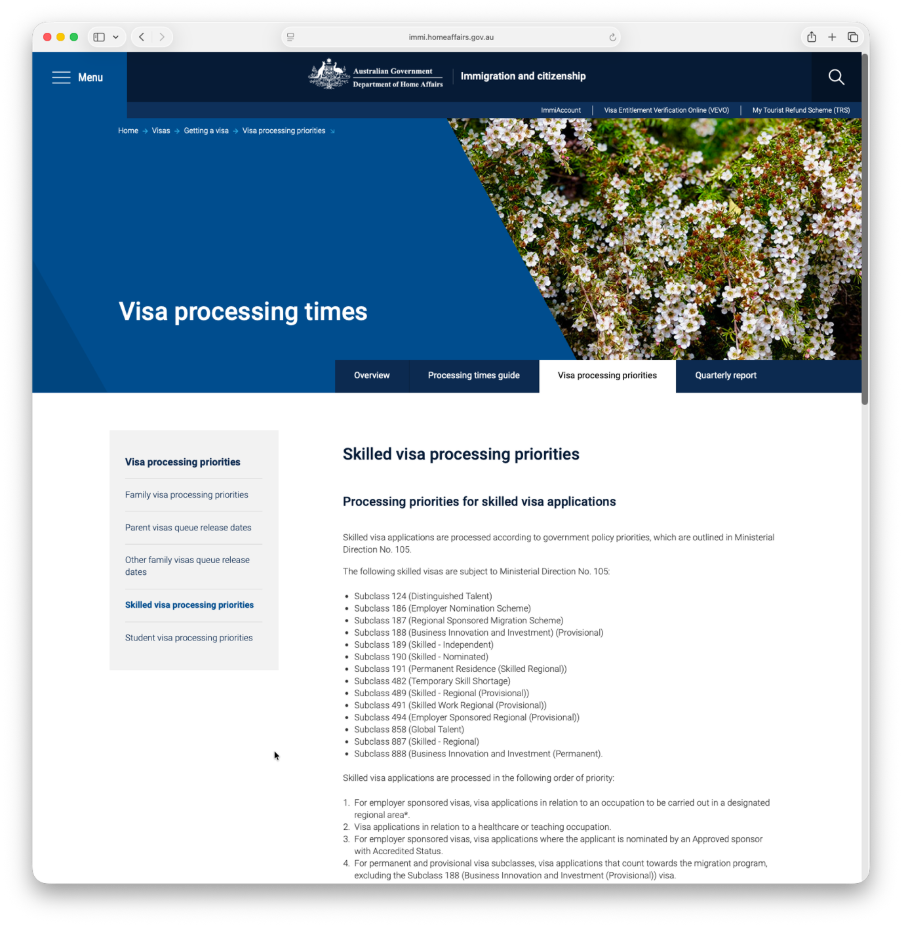
It is important to understand that priority processing is not something you can request or pay for. Instead, applications are assessed based on predefined criteria set by the Minister, regardless of how early the application was lodged.
What Does “Priority Processing” Actually Mean?
Priority processing does not mean guaranteed fast approval.
It means that applications are queued and allocated to case officers in a specific order, based on:
- The occupation
- The industry or sector
- Whether the role supports Australia’s critical workforce needs
Applications that fall into higher priority categories are assessed before others, even if they were lodged later.
The Priority Order for Processing
Here is the current hierarchy under Ministerial Direction No. 105:
- Highest Priority: Occupations in Designated Regional Areas
For employer-sponsored visas (including 482, 494, and 186), applications where the nominated position is located in a designated regional area receive top priority. This reflects the government’s focus on boosting regional economies and addressing labour needs outside major cities like Sydney, Melbourne, and Brisbane.- The subclass 494 visa is inherently regional, so all 494 applications fall into this category by default.
- For 482 and 186 visas, if the job is in a regional postcode, your application jumps to the front of the queue.
- Healthcare and Teaching Occupations
Next in line are applications for roles in healthcare or teaching. This includes a broad range of occupations, such as:- Health Professionals (e.g., nurses, doctors, allied health)
- School Teachers
- Health and Welfare Support Workers
- Child Care Centre Managers
- Psychologists, Social Workers, and more.
These sectors are critical to Australia’s public services, so the government fast-tracks them regardless of location.
- Nominations by Accredited Sponsors
If the sponsoring employer holds “Accredited Status” with the DHA, the application gets elevated priority. Accredited sponsors are recognised as low-risk, compliant businesses that have a track record of meeting sponsorship obligations. This can significantly speed up processing for 482, 494, and 186 visas. - Applications Counting Towards the Migration Program
For permanent and provisional visas (like 186 and 494), those that contribute to annual migration planning levels (excluding certain business innovation visas) are next. - All Other Applications
Remaining applications are processed in the order they were lodged (first-in, first-out).
Applications in lower priorities may take longer than published global processing times, as resources are allocated to higher-priority cases first.
How This Affects Specific Visas
- Subclass 482 (Skills in Demand Visa): As a temporary visa, it benefits greatly from the above priorities. Additionally, the newer streams (Specialist Skills and Core Skills) have targeted fast processing for decision-ready applications – often as quick as 7-21 days in ideal cases. Regional, healthcare/teaching, or accredited sponsor nominations can make it even faster.
- Subclass 494 (Regional Sponsored Provisional): Since this visa requires work in regional areas, it automatically qualifies for the highest priority level. This makes 494 applications among the quickest in the employer-sponsored category, supporting pathways to permanent residency after three years.
- Subclass 186 (Employer Nomination Scheme Permanent): Permanent residency applications can take longer overall, but regional locations, healthcare/teaching roles, or accredited sponsors push them up the list substantially.
Can I Get Priority Processing for a 407 Training Visa?
Although the 407 Training Visa is also an Employer Sponsored visa, there is no priority processing due to the visa being for the nominees benefit and not for the benefit of the employer filling a skill shortage. There can be no economic-benefit argument to push to get attention for the application to be processed, it exists to promote Australia’s international goodwill. Applicants need to therefore expect lengthy processing times as per the Global Processing Times published monthly on the Department of Home Affairs website.
Tips to Maximise Your Chances of Priority Processing
While priority processing cannot be requested, there are clear and practical steps that can significantly improve how quickly a 482, 494, or 186 visa application is assessed:
- Work in a Regional Area
Choosing regional employment is the single biggest factor that can improve visa processing priority.
Regional nominations receive stronger policy support, particularly where employers can demonstrate genuine labour shortages. This applies not only to the 482 visa, but also to Subclass 494 visas and certain Subclass 186 pathways.
Where skills shortages are acute, regional applications are often assessed earlier than metropolitan cases.
- Target Healthcare or Education Occupations
Healthcare and education occupations receive the highest priority processing.
Roles that consistently receive priority include:
- Nurses and midwives
- Medical practitioners
- Aged care and disability support workers
- Early childhood teachers
If your skills align with these sectors, your 482-visa application is far more likely to be processed faster than applications in lower-priority industries such as hospitality or retail.
- Ensure Correct Occupation Classification
Correct occupation classification is critical for priority processing.
If an occupation is incorrectly selected or poorly aligned with a priority sector, the application may lose its priority status entirely. Even small classification errors can lead to substantial processing delays.
- Strive foran Accredited Sponsor Where Possible
Employers with Accredited Sponsor status generally benefit from faster processing and more streamlined assessment.
While accreditation does not guarantee approval, it often reduces administrative delays and supports faster allocation to a case officer.
If an employer is eligible for accreditation, obtaining it before lodging the nomination can materially improve processing outcomes.
- Lodge a Decision-Ready Application
A decision-ready application is essential for priority processing.
This means lodging the nomination and visa application with:
- All required documents provided upfront
- Skills assessments completed (where required)
- Health examinations finalised
- Police clearances uploaded
Applications that require further information are commonly removed from priority allocation and experience avoidable delays.
- Clearly Demonstrate Genuine Workforce Need
The nomination must clearly explain:
- Why the position is essential to the business
- Why the role cannot be filled locally
- How the position supports ongoing operations or service delivery
Clear evidence of genuine workforce need allows case officers to assess the application efficiently and with fewer interruptions.
In practice, well-structured applications in priority occupations—particularly in regional areas—are consistently processed ahead of other cases, even when lodged later.
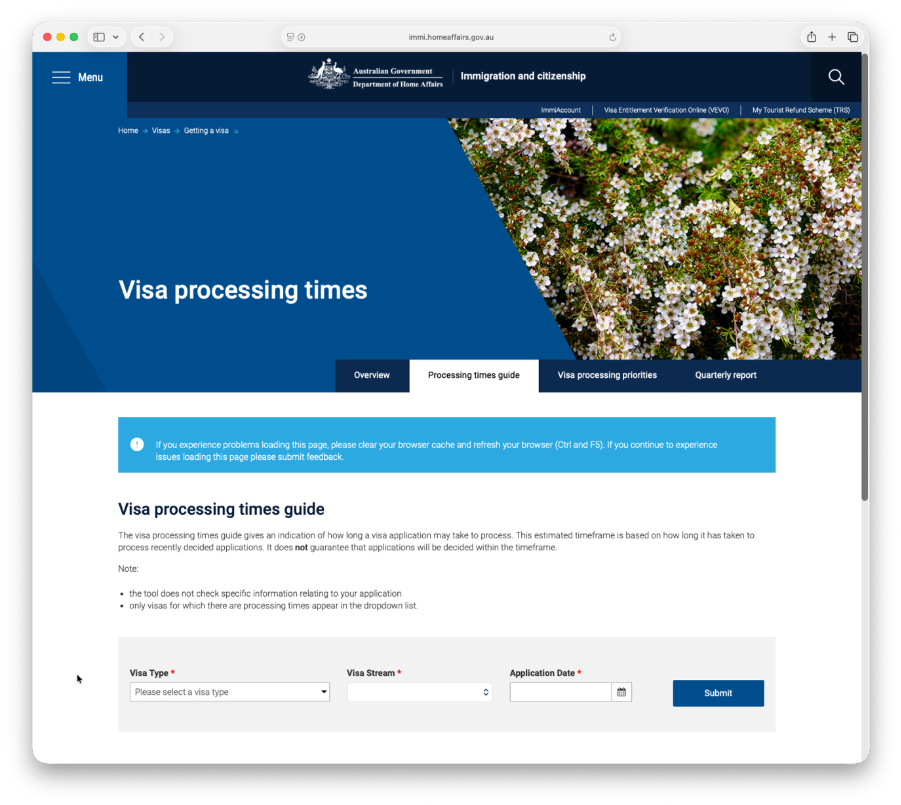
Processing times fluctuate based on application volumes and individual circumstances, so always check the latest global processing times on the DHA website.
Source: DHA website
In summary, priority processing isn’t a mystery – it’s driven by regional needs, critical sectors like health and education, and trusted sponsors. By aligning with these under Ministerial Direction No. 105, many applicants see much faster outcomes.
Ready to Explore Your Options?
Wanting to learn more about the 482, 494, or 186 visas and how priority processing could apply to your situation? Visit our dedicated pages for the 482 Visa, 494 Visa, and 186 Visa for detailed guides and eligibility checklists.
You can also book a free initial consultation with our team. Evan Bishop (MARN 1679414) has specialised in employer-sponsored visas since 2016 and looks forward to assisting you with your skilled migration journey – whether it’s achieving priority processing, navigating nominations, or securing permanent residency.
Contact us today to get started on your Australian visa pathway!
Written and published January 2026. All information provided is accurate as of the date of publishing.

No Comments